Boating License for Buying a Yacht: Which License Do You Need?
Reading time: 6 minutes
Three years ago, I sat across from a buyer who had already decided on a 16-meter flybridge yacht before he even knew which license he'd need to drive it. That conversation ended with him having to complete two courses before he was legally allowed to take the helm of his own boat. This is exactly why the question of a boating license for buying a yacht belongs at the start of your purchase decision, not at the end. Which license you actually need depends on three factors: boat length, type of propulsion, and cruising area.
Here I'll explain how national and international regulations work together, and how you can avoid ending up with the wrong paperwork in hand.
Boating License for Buying a Yacht: Why Boat Size Determines Everything
The answer to the question of the right boating license for buying a yacht always starts with hull length. In Austria, under maritime law, motorboats over 20 hp on inland waters require at least the Austrian boating license, officially called the Kapitänspatent für Kleinfahrzeuge (small craft captain's license). For larger yachts that also head out to sea, this license alone isn't enough.
From roughly 15 meters in length, or for trips further offshore, most coastal states additionally require an offshore certificate, known in Austria as the Hochseepatent. Anyone looking to captain a yacht over 24 meters is usually in territory where a professional crew takes over the helm anyway. Still, many flag states require the owner to hold a valid license personally, even if they're not actively steering.
Which Boating License You Actually Need for a Large Yacht
For vessels over 15 meters in length operating at sea, you'll typically need the offshore certificate combined with an international boating license, the so-called International Certificate of Competence (ICC). Most Mediterranean countries, including Croatia, Italy, and Greece, recognize this document. Without an ICC, a charter inspection in the Adriatic can result in fines ranging from roughly 150 to 500 euros, depending on the country.
If you're planning to charter out your yacht yourself later on, it's worth getting familiar with the legal framework I covered in the article on chartering out your own yacht. There, the skipper's license plays a central role for insurance purposes.
Getting a Sailing License Before Buying a Yacht: Smart or Premature?
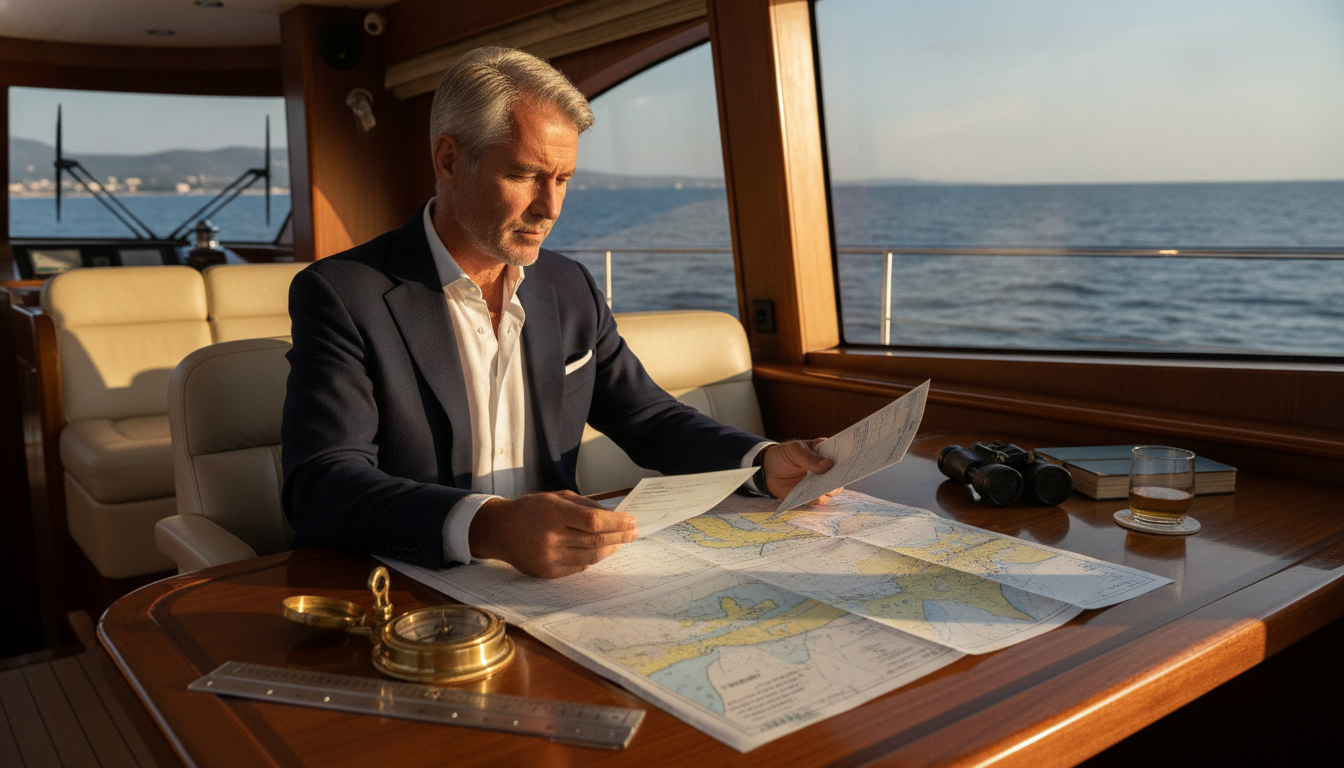
I advise every prospective buyer to get their sailing license or the appropriate motorboat license before finalizing the purchase, not after. The reason is simple: during training, you'll discover which boat size and propulsion type truly match your skill level. Many buyers overestimate their abilities during the first sea trial, as I described in the article on test-driving a luxury yacht.
Courses themselves vary in length. One example from my network: an acquaintance completed his offshore certificate over seven weekend modules at a sailing school, including a practical exam on a lake and a theory exam at the school itself. Other providers offer intensive two-week courses, usually right on the Croatian or Italian coast.
The Difference Between a National License and an International Boating License
The difference between a national license and an international boating license confuses a lot of buyers, but it's actually simple. Your national license is your foundational qualification, issued by the relevant waterway or state authority. The international boating license, the ICC, is a supplementary certificate that makes your national license recognized abroad.
Without an ICC, you can run into trouble during port inspections in countries like Croatia or Greece, even if you hold a valid national license. You apply through the relevant maritime authority, and in Austria it currently costs around 50 euros in administrative fees, according to the Federal Ministry for Climate Action, see bmk.gv.at.
Austrian Boating License for Buying a Yacht: The Key License Classes
For anyone just starting out, I've summarized the relevant license classes in Austria that typically come into play when buying a yacht:
- Small craft captain's license: For boats up to 25 meters on inland waters, the basic requirement for nearly every entry point.
- Offshore certificate: Required for sea voyages, regardless of yacht length, once you leave coastal waters.
- Radio operator certificate (UBI or LRC): Mandatory as soon as a marine radio is on board, which applies to most yachts over 12 meters.
- International Certificate of Competence: Supplementary document for recognition abroad in Europe, especially important for charter destinations like Croatia or Greece.
Anyone choosing a larger motor yacht, such as a Pershing or a comparable performance boat, should sort out the license question alongside the vehicle selection. You'll find more on this in the article on buying a Pershing yacht, where I also cover crew requirements.
Motor Yacht License: The Special Case of Chartering in the Mediterranean
If you plan to charter out your yacht mainly in the Mediterranean or use it yourself there, you'll often need a combination of several credentials. For a bareboat charter in Croatia, most agencies require at least the offshore certificate plus a radio operator certificate, and for yachts over 20 meters, proof of practical sea miles as well. This matches my own experience from the article on berths at Split Marina, where harbor masters regularly check licenses.
Demand for skipper licenses has risen noticeably in recent years. According to the German Sailing Association, more than 14,000 new offshore sport boat licenses were issued in 2023 alone, see dsv.org. This shows how seriously many buyers now take the licensing question before acquiring a yacht.
Boating License for Buying a Yacht: My Recommended Process
From my own experience, I recommend sorting out the license question alongside your market research, not waiting until the purchase contract. This way you avoid buying a yacht you're not initially allowed to pilot yourself. Especially with larger vessels, it's worth planning early with a professional crew until your own license catches up.
If you're already structuring your financing for tax efficiency, you should factor in the costs of licenses and training as well. In the article on tax-efficient financing structures, I go into more detail on these additional costs that many buyers initially underestimate.
Frequently Asked Questions About Boating Licenses for Buying a Yacht
Which boating license do I need for a yacht over 20 meters?
For yachts over 20 meters, you'll generally need the offshore certificate plus an international boating license, often supplemented by a radio operator certificate. Many flag states also require a professional crew.
Is a national boating license enough to buy a yacht abroad?
No, a national boating license alone usually isn't enough for trips abroad. You'll also need the International Certificate of Competence (ICC) so your license is recognized in countries like Croatia or Greece.
How long does it take to get a sailing license?
Depending on the provider, training takes anywhere from two weekends to a full two-week intensive course. The exact duration depends on the theory and practical components and the sailing school you choose.
Do I need a license myself as a yacht owner if I hire a crew?
Many flag states still require the owner to hold a valid license, even if the crew operates the boat. This depends on the country and yacht size, so it's worth checking the flag state's rules in advance.
What does an international boating license cost in Austria?
The administrative fee for the ICC is currently around 50 euros. A prerequisite is that you already hold a valid national license.
The question of the right boating license for buying a yacht often determines how quickly you can actually start enjoying your new boat. Sort out the licensing question early, ideally before you even go to view a yacht, and build realistic training time into your purchase process. If you're unsure which license fits your planned cruising area and yacht size, it's worth talking to a sailing school before committing to a particular model.