Flag Registration: The Best Country for Your Boat

Reading time: 9 minutes
When I bought my 24-meter Azimut in 2019, I faced a decision that would affect my annual costs by up to $51,000: boat flag registration. My tax advisor in Vienna put three folders on the table: Malta, Cayman Islands, Gibraltar. Choosing the right flag decides not only your tax burden and insurance premiums, but also which ports you can enter without problems and which crew regulations apply.
Boat flag registration determines the legal home country of your vessel. While many first-time buyers automatically choose the flag of their country of residence, experienced owners deliberately use international ship registries. I registered my yacht under the Maltese flag, a decision I explain in detail in this article, including concrete costs and legal pitfalls.
Why yacht registration countries differ so much
Every country has its own maritime laws, tax rates and requirements for vessel owners. Choosing your boat's flag is not a mere formality. Austria has no seagoing ship registry, so we yacht owners have to turn abroad anyway. That opens up opportunities, but it also carries risks if you don't know the details.
Malta, for example, charges no VAT on yachts over 24 meters if you can prove that the boat operates outside EU waters more than 50 percent of the time. My Azimut is mostly in Corsica and Turkey, so I save around $41,000 a year here. The British Red Ensign, on the other hand, brings advantages with insurance: many insurers grant up to a 12 percent discount because UK-registered yachts are subject to stricter safety audits.
Comparing the most important European ship registries
Four registries dominate the luxury yacht market in Europe. Malta leads with more than 9,600 registered yachts (as of 2024, according to Transport Malta), followed by the British Overseas Territories. Each of these European ship registries has specific advantages and disadvantages that I know from my own experience and from conversations with other owners.
Malta scores with EU compliance and low running costs. The annual registration fee for my 24-meter yacht is $2,000. Gibraltar offers similar advantages but is sometimes viewed critically by harbor authorities in France and Spain, a detail I only noticed when I was confronted with longer customs checks in Saint-Tropez. The Isle of Man registry is more expensive, but it brings prestige and makes crew contracts with non-EU citizens easier.
Maritime tax advantages worked out in detail
Maritime tax advantages vary drastically depending on the registry. I have put together a sample calculation for you based on a 20-meter motor yacht with a purchase price of $2.6 million. These figures come from my own accounting and conversations with my tax advisor in downtown Vienna, the firm Hofmann & Partner.
Under the Austrian flag you would not be able to register directly, but you would have to pay full VAT when using the yacht in EU waters: $520,000. Under the Maltese flag, with correctly documented use outside the EU: $0 in VAT. The annual tonnage tax in Malta for this size is around $1,300. The Cayman Islands charge no income tax on charter income, but have higher registration fees of around $4,900 a year and stricter audit requirements.
An important point is import taxes. If you want to use your yacht permanently in EU waters, you have to prove or pay the VAT. Malta and other EU registries allow the so-called VAT-paid status, which gives you free passage in all EU ports. With non-EU flags such as the Cayman Islands it gets more complicated: here you either need a temporary import permit (TIP) or have to move the yacht out of EU waters every 18 months.
Which country to choose for flag registration when buying a boat: my decision criteria
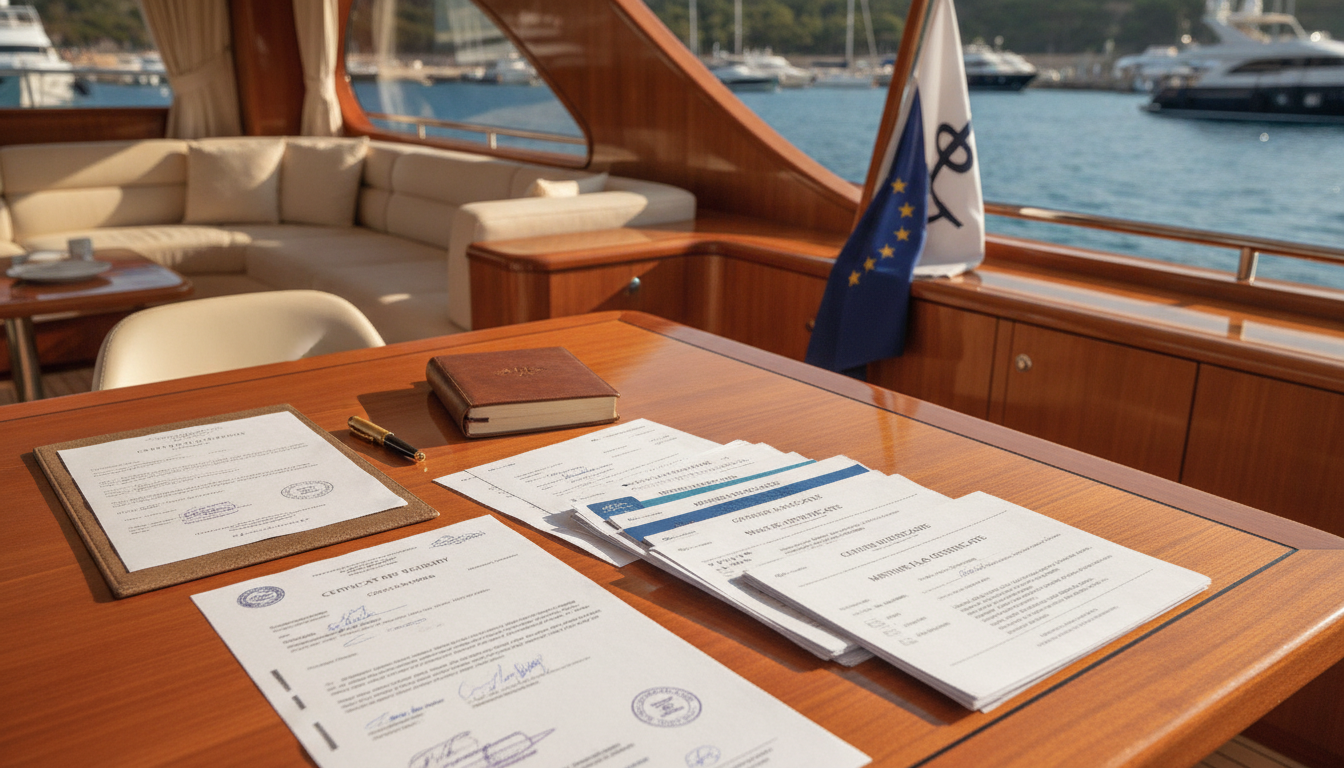
When I faced the question of which country to choose for flag registration when buying a boat, I defined six criteria that were relevant to me as an entrepreneur and frequent user. These criteria help you make a structured decision instead of being dazzled by supposed tax havens.
- Main area of use: where does my yacht lie and sail most of the time? EU waters call for different considerations than the Caribbean or Southeast Asia.
- Total tax burden: calculate not just registration costs but also VAT, tonnage tax and income tax on charter revenue.
- Acceptance in destination ports: some flags lead to longer inspections or bureaucratic effort in certain countries.
- Crew regulations: which nationalities may I employ, which working-time laws apply, which social security obligations arise?
- Resale value: flags with a good reputation make selling easier, as buyers often shy away from complicated re-registrations.
- Administrative effort: annual audits, safety certificates, accessibility of the authorities. These factors cost time and nerves.
For me the decision was clear: Malta. In summer my yacht is mostly between Croatia and the Côte d'Azur, in winter often in Turkey. The EU flag gives me problem-free access to all Mediterranean ports, the tax structure is transparent, and my lawyer in Valletta, the firm Fenech & Fenech, responds to inquiries within 24 hours. If your usage profile looks similar, Malta is hard to beat.
Tax advantages of registering a vessel abroad: the reality
The tax advantages of registering a vessel abroad are often exaggerated. Yes, you can save, but only if your structure is watertight and you document usage correctly. I keep a digital logbook of every berth, every trip, every day my yacht leaves EU waters. This data is worth its weight in gold if the tax office asks questions.
An acquaintance from the Viennese business scene registered his yacht in the Cayman Islands without documenting usage. When the Austrian tax office got wind that the yacht lay almost exclusively in Croatia, it retroactively demanded the full VAT plus interest, more than $560,000. Mistakes like this are avoidable if you calculate honestly from the start and the flag matches your actual usage profile.
Malta flag or Cayman Islands for a luxury boat: a direct comparison
The question of Malta flag or Cayman Islands for a luxury boat comes up in every yacht buyer conversation. Both registries are popular but serve different needs. Malta is the EU solution, the Cayman Islands the international alternative. I only have experience with Malta myself, but I spoke with an owner from Salzburg who registered his 28-meter Sunseeker in the Caymans and shared his numbers with me.
Malta requires a Maltese company as owner or an EU citizen as registered owner. Setting up a Maltese Ltd. costs around $3,000, and the annual fees are about $1,300. In return you get an EU flag recognized in every port from Monaco to Mykonos. The Cayman Islands allow direct registration by individuals, the annual fee is $4,900, plus mandatory annual audits by approved surveyors (approx. $3,500).
The biggest difference lies in VAT. With the Malta flag and correct use, you can legally avoid VAT if you operate outside EU waters more than 50 percent of the time. With the Cayman flag you pay no VAT to the Caymans anyway, but when entering EU waters you must either apply for a TIP (temporary, up to 18 months) or pay the VAT in full. For someone who sails primarily in the Mediterranean, Cayman makes no sense. For globetrotters who are rarely in EU waters, it can be the better choice.
Discovering the legal differences between European ship registries
Discovering the legal differences between European ship registries means dealing with labor law, safety regulations and liability questions. Malta is subject to EU law, which means EU working-time directives, EU environmental requirements, EU safety standards. Gibraltar and the Isle of Man are British overseas territories but have their own variations of these rules. Cyprus, in turn, has a very liberal registry that is sometimes viewed critically by harbor authorities.
My crew is from Croatia and Italy; with the Maltese flag the contracts are EU-compliant and social security runs smoothly. An acquaintance with a Panama flag regularly struggles with labor law issues because his Filipino crew is sometimes not allowed to work in EU ports or needs special visas. Details like these sound trivial but can massively hinder operations. The operating costs of a superyacht rise quickly if you constantly have to pay lawyers and visa agents.
Liability and insurance: often overlooked details
Liability rules differ considerably depending on the flag. Malta and UK registries follow international conventions such as the Athens Convention, which governs passenger claims. Some flags of convenience have not ratified these conventions, which can lead to massive legal disputes in the event of damage. My insurer (Pantaenius, Hamburg) made it clear to me: the Malta flag means an 11 percent lower premium than with a Panama or Belize flag.
In an accident off the Corsican coast in 2021, when another boat rammed my stern area, the Maltese flag was worth its weight in gold. The French marine accident investigator accepted my documents without follow-up questions, and the insurer paid within six weeks. An owner with a Panama flag who was moored in the same harbor waited more than five months for resolution because the French authorities demanded additional translations and certifications.
The hidden costs of choosing a flag
Besides the obvious fees, there are hidden costs that should influence your decision. I always factor these items into my overall calculation, because they add up over the years. If you want to learn more about hidden cost traps when buying a yacht, it is worth a look at my detailed analysis.
Annual surveys and certificates: Malta requires a comprehensive Safety Equipment Certificate every five years, costing around $2,600. UK registries require annual checks, each around $1,950. Legal costs: with complicated registries such as the Marshall Islands you often need local lawyers for every change (change of owner, mortgage, name change), which can mean an additional $3,200 to $5,400 a year. Currency risks: fees in exotic currencies can become more expensive through exchange-rate fluctuations.
Another point is re-registration costs on sale. Many buyers want to change the flag, which causes additional costs. If you have a Malta flag and the buyer also wants Malta, that saves both sides money and speeds up the sales process. That can indirectly raise the sale price by 2-3 percent, because you are seen as an uncomplicated seller.
My conclusion: how to choose the right flag
Boat flag registration is a strategic decision, not a bureaucratic formality. For most owners in the Mediterranean, Malta is the optimal choice: EU compliance, moderate costs, broad acceptance. If you operate primarily outside the EU, it is worth looking at the Cayman Islands or the Isle of Man. I advise against flags of convenience such as Belize or Panama based on experience, as the short-term savings are more than eaten up by extra effort and loss of reputation.
My recommendation: first define your usage profile, calculate all costs over five years and talk to a specialized lawyer. The investment of $1,600 in professional advice saves you tens of thousands later. I researched for three months before deciding on Malta, and to this day I haven't regretted it for a second. The right flag gives you freedom, security and predictable costs. The wrong flag costs you nerves, money and, in the worst case, access to your favorite ports.
Frequently asked questions about choosing a boat flag
Can I change my yacht's flag later?
Yes, a change of flag is possible at any time, but it causes costs between $3,200 and $8,600 depending on the destination and origin registry. You have to delete the old registration, have all certificates reissued and, if necessary, sort out VAT again. For me, the theoretical switch from the British to the Maltese flag took about eight weeks back then.
Which flag is best for charter yachts?
For commercial charter, Malta, the UK (Red Ensign) and the Cayman Islands are the first addresses, because they meet international Commercial Yacht Codes and are accepted by most charter insurers. Malta additionally offers the advantage that you can charter within the EU without further permits.
Do I have to appear in person in the country of registration?
No, with most registries you can handle everything by power of attorney and remote communication. For my Malta registration I was never physically in Valletta once; everything went through my lawyer and digital signatures.
How long does a new registration take?
Between four and six weeks for Malta, about three to four weeks for the UK, six to eight weeks for the Cayman Islands. Express services are available for an extra fee and cut the time to ten to 14 days.
Which documents do I need for boat flag registration?
As standard: purchase contract or Builder's Certificate, proof of the owner's identity, proof of VAT status, a current Safety Equipment Certificate, proof of liability insurance and, with some registries, a Bill of Sale. For company ownership, commercial register extracts and shareholder documents are added.