Sunseeker vs. Azimut: Which Yacht Builder Is Right for You?

Reading time: 11 minutes
Three years ago, I stood in Port Adriano in Mallorca between a Sunseeker Predator 68 and an Azimut S7, both in a similar price bracket of around $3.1 million. The decision felt like choosing between an Aston Martin and a Ferrari: both excellent, but fundamentally different in their DNA. The Sunseeker vs. Azimut comparison occupies many prospective buyers, and I understand why: it is about more than technical data, it is about lifestyle, intended use and ultimately an investment you will see and experience daily for years.
In this article I share my insights from seven years of yachting experience, dozens of shipyard visits in Poole and Avigliana, and countless conversations with owners of both brands. I will show you the key differences between British and Italian boatbuilders so that you can make the right decision for your needs.
The Philosophy: British Precision vs. Italian Design
Sunseeker, from Poole in Dorset, has been building motor yachts since 1969 with a clear focus on performance and British engineering. When I step aboard a Sunseeker, I immediately notice the thought-out ergonomics. Every switch, every trim strip sits where you intuitively expect it. The build quality is reminiscent of precision mechanics, panel gaps are minimal, the paintwork is flawless. The Predator range focuses on sporty performance with a V-shaped hull and aggressive styling.
Azimut, from Avigliana near Turin, has followed a different approach since 1969. Italian design dominates here, often in collaboration with renowned studios such as Stefano Righini. The lines are more flowing, the interiors more opulent. During my visit to the Avigliana yard in 2022, a production manager told me that Azimut invests an average of 15 percent more hand-labor hours in interior fit-out than comparable British boatbuilders. You can see it in details like hand-laid inlays, customizable fabric combinations and a broader palette of marble and wood options.
According to an analysis in the Superyacht Intelligence Agency Report 2023, 68 percent of northern European buyers prefer Sunseeker, while 72 percent of Mediterranean owners choose Azimut. This geographic preference reflects different usage habits: northern Europeans value the robust construction for rougher waters, while Mediterranean owners place more emphasis on aesthetics and entertaining space.
Performance and Seaworthiness Head to Head
When you are buying a sports cruiser, performance plays a central role. I tested both yards in similar conditions in the Bay of Palma. The Sunseeker Predator 68 with two MAN V12 1,400 hp engines consistently reached 38 knots, accelerated from 0 to 30 knots in 18 seconds and remained astonishingly stable in the water even in 2-meter waves. The deep V hull cuts through the waves instead of bouncing over them, which is significantly more comfortable on longer passages.
The Azimut S7 with comparable engines reached 36 knots and needed 21 seconds for the same acceleration. The flatter hull angle provides more interior headroom and volume, but makes the boat more susceptible to beam seas. On our trip from Mallorca to Ibiza in 1.5-meter waves and force 5 winds, the Azimut rolled noticeably more than a comparable Sunseeker that I drove two weeks later in similar conditions.
Fuel consumption differs noticeably: at a cruising speed of 28 knots, the Sunseeker burned 240 liters per hour, the Azimut 265 liters. On a typical Mallorca-Ibiza run of 90 nautical miles, that means a difference of around 80 liters; at current marina prices of about $2.00 per liter, that is $160 per trip. Over a season of 20 such trips, that adds up to roughly $3,200.
Build Quality and Choice of Materials
In the Sunseeker vs. Azimut comparison, fundamental differences in material philosophy emerge. Sunseeker consistently relies on GRP laminate with vinylester resin, which protects better against osmosis than standard polyester resin. The hulls are laminated in closed molds under controlled temperature, which ensures uniform wall thicknesses. During my yard tour in Poole in 2021, I saw how every layer is checked for air pockets by ultrasound, a level of quality otherwise known only from aircraft manufacturers.
Since 2017, Azimut has increasingly used carbon composites, especially in the Flybridge series. This saves weight in the superstructure, which has a positive effect on stability and fuel consumption. According to factory figures, the topside weight of an Azimut Fly 68 is reduced by 420 kilograms compared with conventional GRP construction. However, carbon repairs are considerably more expensive: repairing a damaged carbon railing cost an acquaintance at the Palma yard $9,300, while a comparable stainless steel railing repair on my yacht cost just $2,300.
The interiors differ strikingly. Sunseeker prefers oak and subtle leather upholstery in muted colors. The electrical system comes from CZone, a New Zealand manufacturer considered particularly reliable. Azimut relies on Italian furniture makers such as Poltrona Frau for leather upholstery and offers walnut, zebrano or high-gloss lacquer in various shades. The electrical systems from Dometic and CBE are solid but, in my experience, more prone to Mediterranean humidity problems.
Resale Value and Value Retention
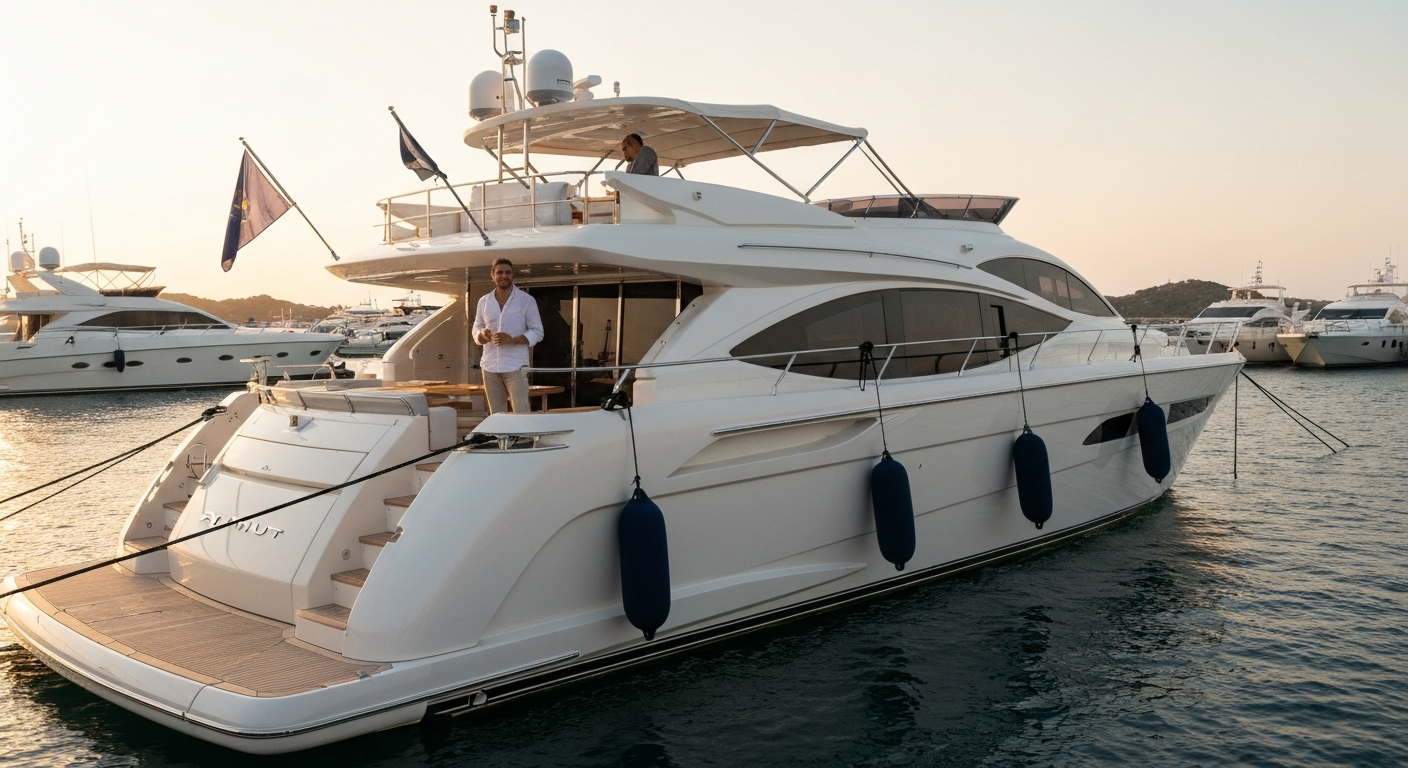
A key question when buying a sports cruiser is value retention. According to the Used Boat Price Index from YachtWorld.com, Sunseeker models retained an average of 58 percent of their new price after five years between 2018 and 2023. Azimut models reached 52 percent. The difference lies mainly in demand on the used market: Sunseeker has a loyal buyer base in northern Europe and Scandinavia, where performance cruisers remain in demand.
For specific models, this varies widely. A 2017 Sunseeker Manhattan 66, new price $2.64 million, still fetched $1.6 million in 2022, or 60 percent. An Azimut 66 Fly from the same year, new price $2.59 million, changed hands for $1.27 million, equivalent to 49 percent. These figures come from my own market observation on YachtWorld and boat24.com over 18 months.
One factor is operating costs. Sunseeker spare parts are readily available through the Europe-wide dealer network, but expensive. A set of shaft seals cost me $2,000. Azimut parts often have to come from Italy and take longer, but are usually 20 to 30 percent cheaper. Annual maintenance on a comparable 65-foot yacht costs around $24,000 for a Sunseeker and about $20,000 for an Azimut, according to the experience of several owners at Marina Port Vell in Barcelona.
Which Yard Suits Which Use?
If you mainly cruise the Mediterranean, rarely go out in difficult conditions and value sociable evenings on board, there is a lot to be said for Azimut. The generous flybridges, spacious cockpits and elegant interiors create an atmosphere that fits the Mediterranean lifestyle perfectly. For a yacht vacation in Mallorca with friends, anchoring in coves by day and dining in Port Adriano in the evening, an Azimut Fly is the ideal platform.
If, on the other hand, you plan longer deliveries, often sail in suboptimal weather or value sporty performance, Sunseeker is the better choice. The Predator and Portofino ranges are true all-weather sports cruisers that remain controllable even in 3-meter waves. For owners in northern Europe who want to go, say, from Hamburg to Heligoland or from Oslo to the skerries, Sunseeker offers the sturdier platform.
From a financial perspective, Sunseeker pays off if you want to sell the boat again after five to seven years. The higher resale value partly offsets the more expensive entry price. If you plan to keep the boat for ten years or longer, resale value plays a smaller role, and Azimut's lower operating costs might then matter more. Those who built their wealth through smart investments, for example through getting rich with real estate strategies, often think more long-term and give more weight to running costs.
Dealer Network and Service Infrastructure
Sunseeker operates 70 authorized sales and service partners worldwide, 28 of them in Europe. In Austria there is no direct representative; the nearest are in Croatia (Marina Punat, Krk) and Italy (Portofino). For maintenance and repairs, that sometimes means longer travel distances. In return, service quality is consistently high, and technicians go through standardized training in Poole.
Azimut has 138 service points worldwide, 45 of them in the Mediterranean. Croatia alone has five authorized service partners, Greece seven. For Mediterranean owners, that means shorter distances and faster response times. Service quality varies more, however. At Marina Frapa in Rogoznica I had excellent experiences with the local Azimut technician, whereas in Athens a simple hydraulic repair took three weeks instead of the promised five days.
Both yards offer extended warranty programs. For five years of full warranty on a 65-foot yacht, Sunseeker charges around $94,000 and Azimut $79,000. These warranties cover engine, transmission, electrical system and hull, but not wear parts such as upholstery or electronics. In my view, it only pays off if you use the boat intensively or sail in difficult waters.
Customization Options and Build Times
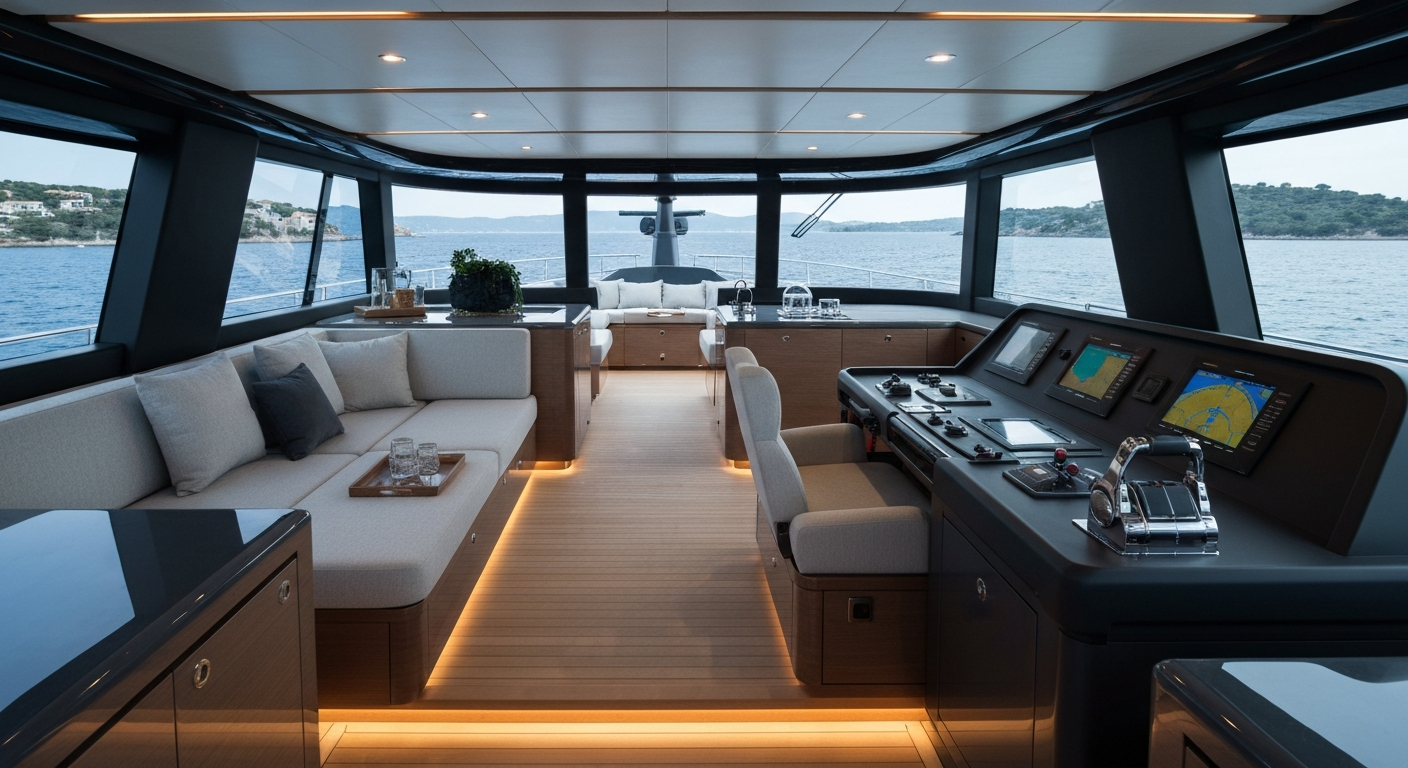
When it comes to personalization, Azimut offers more leeway. The layout can often still be adjusted at an advanced stage of construction, and the color palette is more extensive. I know an owner who had his Azimut 72 Fly fitted with a complete teak cockpit, custom-made bar furniture and a Bang & Olufsen entertainment system, all factory-integrated. The surcharge was $375,000, but the result was one of a kind.
Sunseeker is more restrictive with special requests. This has the advantage of shorter build times: from order to delivery takes 12 to 16 months at Sunseeker and 16 to 22 months at Azimut. For impatient buyers or those with a fixed delivery date, Sunseeker is the better choice. However, the resale value of heavily customized yachts drops, as potential buyers may not share the previous owner's personal taste.
Equipment Options in Detail
Both yards offer extensive option lists. Sunseeker highlights include hydraulic swim platforms (from $50,000), Lumishore underwater lighting ($9,500) and Seakeeper stabilizers (from $130,000). Azimut scores with integrated water toy garages, extendable balconies on the flybridge (from $70,000) and complete spa areas with sauna and steam bath (from $105,000).
The electronics are at a high level at both yards. Sunseeker uses Raymarine multifunction displays as standard, Azimut uses Garmin. Both systems are mature, ultimately a matter of taste. More important is integration: Sunseeker offers complete CZone wiring from the factory, which makes later retrofits easier. Azimut systems are often wired proprietarily, which makes expansions more complicated.
The Cost of Boat Love: Realistic Operating Costs
Besides the purchase price, running costs are decisive. For a 65-foot yacht from either yard, I calculate the following annual costs: a berth in a good marina (Palma, Athens, Split) $38,000 to $60,000 depending on location, insurance $20,000 to $27,500 depending on cruising area and deductible, maintenance and repairs $22,000 to $33,000, winter storage or preservation $13,000 to $20,000.
Then there is fuel. At 100 operating hours per season, a Sunseeker with mixed driving consumes around 18,000 liters ($36,000), an Azimut about 20,000 liters ($40,000). If you often run at top speed, expect double. A realistic total calculation comes to $130,000 to $200,000 per year, depending on intensity of use.
According to a 2023 study by the European Boating Industry, average operating costs are 15 to 20 percent of the new price per year. For a $2.75 million yacht, that is $410,000 to $550,000. These figures, however, also include professional crews, which are usually not needed in our scenario. For owner-operators like me, $130,000 to $165,000 is more realistic.
Frequently Asked Questions About the Sunseeker vs. Azimut Comparison
Which yard has better resale values, Sunseeker or Azimut?
After five years, Sunseeker achieves an average of 58 percent of the new price, Azimut 52 percent. Sunseeker benefits from strong demand in northern Europe and Scandinavia, where robust performance cruisers are in demand. The difference of six percentage points corresponds to roughly $165,000 after five years on a $2.75 million yacht.
How specifically do British and Italian boatbuilding differ?
British boatbuilders like Sunseeker focus on engineering, robust construction and performance. The deep V hull, precise workmanship and conservative design come first. Italian boat manufacturers like Azimut place more emphasis on aesthetics, generous volume and opulent interiors. The hulls are flatter for more interior headroom, the design more flowing and expressive. British yachts are typically more seaworthy in rough weather, while Italian ones offer more comfort in Mediterranean conditions.
Which yard is better suited for Mediterranean use, Sunseeker or Azimut?
For purely Mediterranean use in mostly good weather, Azimut is the more comfortable choice. The generous outdoor areas, spacious flybridges and the extensive service network in the Mediterranean are clear advantages. Sunseeker scores if you also head out in worse weather or near the Atlantic. For a yacht vacation in Greece with lots of island hopping, both are suitable; Azimut offers the more elegant ambiance, Sunseeker the sportier performance.
What does maintenance on a Sunseeker cost compared to an Azimut?
A 65-foot Sunseeker costs about $24,000 per year in maintenance, a comparable Azimut around $20,000. Sunseeker spare parts are more expensive but better available. Azimut parts are cheaper but need longer delivery times. Over a ten-year holding period, the difference adds up to about $40,000 in Azimut's favor, which is partly offset by Sunseeker's better resale value.
Which motor yacht builders build more fuel-efficiently, Sunseeker or Azimut?
Sunseeker tends to be more fuel-efficient thanks to the optimized V hull and lower weight in the superstructure. On a 65-foot yacht, the difference is around 10 to 15 percent in Sunseeker's favor. At 100 operating hours per season, that is roughly 2,000 liters or $4,000 saved per year. However, since 2022 Azimut has optionally offered carbon constructions that reduce consumption, in which case the difference shrinks to about 5 percent.
My Personal Conclusion: The Decision Lies in Your Usage Profile
After seven years of intensive yachting experience and a direct Sunseeker vs. Azimut comparison, my recommendation is clear: there is no objectively better yard, only the one that suits your needs better. If performance, seaworthiness and value retention are priorities, you often sail in demanding conditions and value British quality standards, Sunseeker is your yard. The higher purchase and maintenance costs are partly offset by better resale values and lower fuel consumption.
If your focus is on Mediterranean lifestyle, elegant aesthetics and generous entertaining space, you mostly sail in good weather and appreciate Italian design, then everything speaks for Azimut. The lower operating costs and the denser service network in the Mediterranean are practical advantages that you will notice in everyday use.
Regardless of your choice, I recommend doing at least two test drives in different conditions before buying, talking to current owners and having an independent survey carried out. A yacht is a long-term relationship, not an impulse purchase. Take the time to experience both philosophies before you commit. The right yacht is waiting for you, whether from Poole or Avigliana.