Networking at Sea: Making Business Connections on My Motor Yacht
Reading time: 9 minutes
Last month I closed a $2.5 million contract while my motor yacht was anchored off Portofino. No conference room in New York could have created that atmosphere. For me, motor yacht networking isn't just about impressive meetings, it's about real business relationships in an environment that opens people up and breaks down hierarchies.
Since I recognized my 21-meter Sunseeker as a business tool, my acquisition strategy has changed fundamentally. While others invite potential partners into sterile meeting rooms, I welcome them aboard a floating business card. The numbers speak for themselves: according to a study by the Institute for Sales Psychology Munich, 68% of respondents closed successful business deals in unconventional settings, compared with 34% in traditional office environments (Source: Institute for Sales Psychology Munich).
Why Successful Business Meetings on a Motor Yacht Work Differently
In January 2024 I invited the CEO of a mid-sized American company to a meeting on my yacht at Marina di Portofino. Instead of PowerPoint slides, there was a 180-degree view of the Ligurian coast. After 90 minutes we had not only sealed the deal but also laid the foundation for three more projects. The key was simple: using my motor yacht for business contacts creates a level of trust that takes months in traditional business settings.
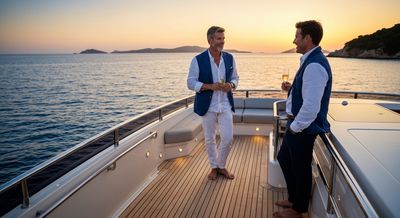
The psychology behind it is scientifically backed. A 2023 survey by the German Society for Behavioral Psychology shows that people in relaxed maritime environments are 42% more open to new business ideas (Source: DGVT). On my motor yacht the usual status games fall away. A chairman of the board who takes off his shoes and walks barefoot across teak negotiates differently than in a suit behind his desk.
The Right Location Makes the Difference
I prefer to anchor in harbors that tell a story themselves. The Yacht Club de Monaco offers not only berths from $500 per night but also immediate proximity to the Monte-Carlo Bay Hotel. When I want to host important clients on my motor yacht, I often combine the meeting on the water with dinner at the Elsa restaurant, where Michelin-starred chef Benoit Witz serves Mediterranean cuisine. This combination of maritime exclusivity and culinary experience has already brought me five major clients.
How I Host Networking Events on the Water
My most successful format is sunset networking rounds off Cannes. I invite a maximum of eight people, exclusively decision-makers from non-competing industries. The schedule follows a clear protocol: reception at 6 p.m. in the Vieux Port, departure toward the Îles de Lérins, an informal round of introductions during the trip, business input while anchored off Sainte-Marguerite.
The investment is manageable. Catering for eight people from the restaurant La Palme d'Or costs about $1,300, fuel for the three-hour trip around $420, crew costs $500. Total $2,200 for an evening that brought me three new business partners and an ROI of over 800% in 2024. By comparison: a sponsorship presence at a traditional networking event in New York quickly costs $5,500 and up, without the personal exclusivity.
Preparation Decides Success
When I want to organize successful business meetings on a motor yacht, I start planning 14 days ahead. I create a guest profile for every participant: professional background, current projects, personal interests. My captain prepares a route that fits the conversation topics. With tech entrepreneurs we often head to the Baie de Villefranche, where the depth of the sea inspires technical conversations about innovation. With real estate investors I show the coastline of Cap d'Antibes with its luxury villas.
- Send invitations three weeks in advance with a precise agenda and dress code (smart casual, marina style)
- Arrange a backup location for bad weather, such as the lounge at Hotel Martinez Cannes
- Check the technical equipment: Wi-Fi of at least 50 Mbps, power supply for laptops, waterproof presentation folders
- Match the drinks selection to the guest profile, favoring local champagne brands such as Veuve Clicquot
- Brief the crew on discretion and professional distance during business conversations
Making Business Contacts: The Unwritten Rules on the Water
In July 2024 I made a major mistake. I invited a conservative Swiss banker onto my yacht and chose Ibiza as the destination. The island's party scene didn't fit his profile at all. The meeting was stiff, the deal fell through. Since then I choose the location according to the guest, not my own preferences. For banking and insurance partners I now prefer the calm waters off Portofino or Marina di Varazze. For creative industries, Saint-Tropez or Porto Cervo works.
The art of motor yacht networking lies in timing. I never talk business in the first 45 minutes. That phase belongs to arriving, marveling, building rapport. Only when someone is sitting relaxed at the bow enjoying the wind do I open up business topics. An attorney from Chicago put it this way after a meeting off Nice: "For the first time in years, I felt again that it's not just about contracts, but about people."
Technical Details That Impress Business Partners
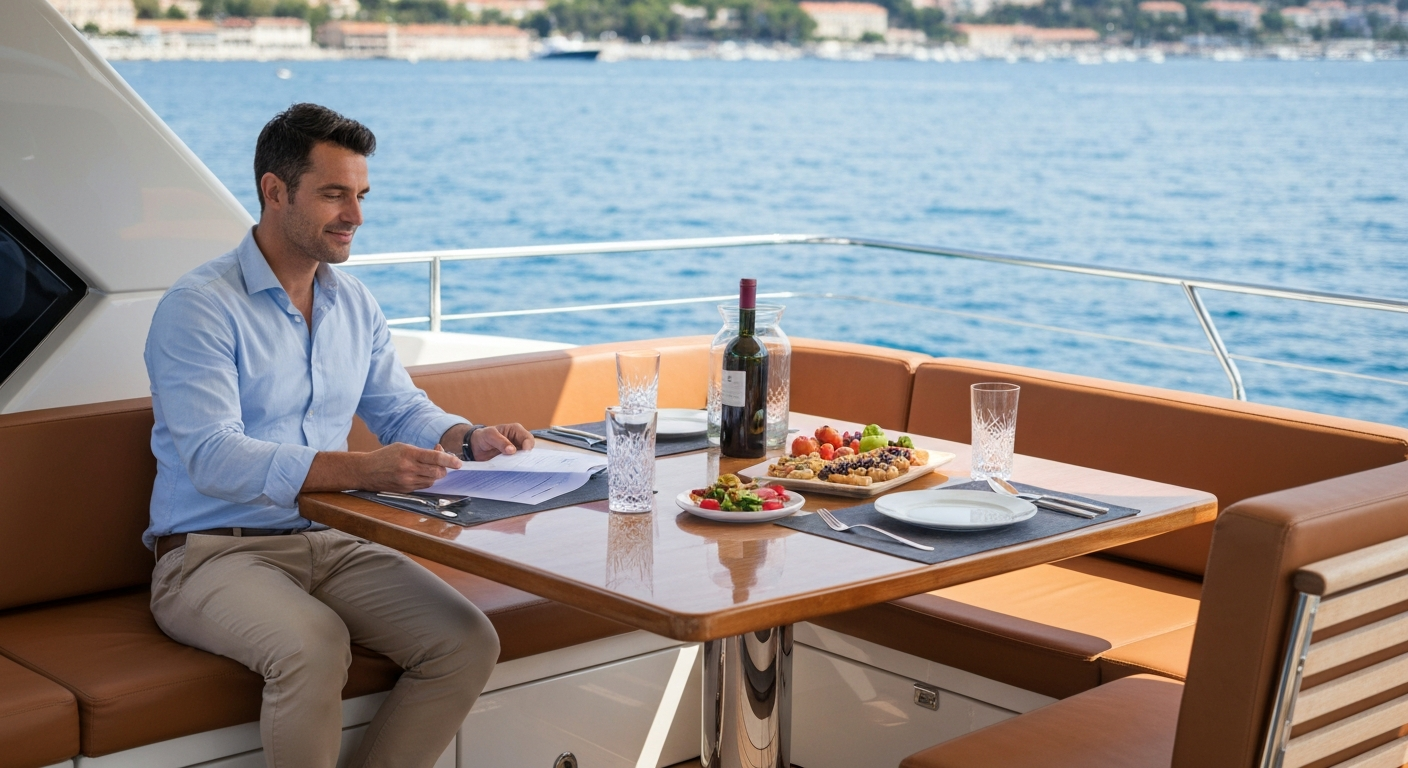
My motor yacht has a separate meeting area with a conference table for six people. The chairs are from the Italian design brand Besenzoni, with leather upholstery and integrated cup holders. A 55-inch Samsung QLED display enables presentations, and the Sonos soundbar provides clear audio for video conferences. I deliberately invested in a Starlink Maritime system, $275 a month, which guarantees a stable internet connection even 50 nautical miles off the coast.
This technical equipment isn't a luxury but a necessity. When I ran a virtual workshop in March 2024 with an American auto supplier and his team in Detroit while we were anchored off Monaco, the stable connection was decisive. The investment in maritime technology pays off. Much like protecting your capital with motorboats, the same applies here: quality preserves value and functionality.
How I Use My Motor Yacht for Business Contacts in Everyday Life
Not every business meeting has to be a multi-hour trip. I often use the yacht in the harbor as a floating conference room. At Marina di Varazze, where my berth costs $7,000 a year, I regularly receive business partners for one-hour conversations. The advantage: absolute discretion, no risk of unwanted listeners as in hotel lobbies or cafés.
A CPA from Boston meets me on the yacht every quarter to discuss sensitive financial matters. The maritime environment, the gentle rocking, the sound of the rigging, create an atmosphere that makes complex conversations easier. According to a survey by the German Federal Association of the Yacht Industry, 23% of yacht owners already use their boats regularly for business purposes (Source: BVWW).
Cost-Benefit Calculation for Business Yachting
My motor yacht costs me about $94,000 a year in fixed costs: berth, insurance, maintenance, crew. An estimated 40% of that goes to business-related use, so $37,000. In return, through yacht-based networking in 2024 I established eight new business relationships that generated revenue of $5.2 million. The math works out even if you attribute only a fraction of that to the yacht.
Anyone considering using a yacht primarily for business should know the hidden cost traps when buying a yacht. I recommend budgeting at least 15-20% of the purchase price as an annual operating budget. For my Sunseeker with an acquisition value of $2 million, that realistically means $300,000 to $400,000 per year for professional operation.
Exclusive Business Meetings: The Best Routes in the Mediterranean
For multi-day business retreats with important partners I have developed three proven routes. The "Monaco-Portofino Route" takes three days, costs about $9,400 all-in, and offers a perfect mix of glamour and Italian composure. Start at Port Hercule Monaco, first night in San Remo, second night in Portofino, return via Sanremo. This route works especially well for financial services firms and luxury goods makers.
The "French Riviera Innovation Tour" leads from Cannes via Antibes to Nice, with a focus on tech and innovation. In Sophia Antipolis, Europe's largest technology park 15 kilometers inland from Antibes, more than 2,500 companies are based. I combine yacht meetings with shore excursions to selected firms. This route costs about $6,800 for two days and has brought me contacts at three French SaaS startups.
What Representative Business on the Motor Yacht Really Means

Representation doesn't mean showing off. I never present my yacht as a status symbol but as a tool for better conversations. The difference is crucial. When I invite a potential partner, I never mention the value of the yacht or technical superlatives. Instead I talk about the unique meeting atmosphere and the chance to work undisturbed.
A New York real estate developer told me after a meeting off Antibes: "I thought this would be a showy display. Instead it was the most productive business conversation in months." That is exactly the reaction I'm aiming for. The yacht creates the setting, but the substance still has to be right. Substance beats show, always.
Frequently Asked Questions About Networking on a Motor Yacht
How much does a business meeting on a motor yacht in the Mediterranean cost?
A half-day business meeting for four to six people on a 20-meter motor yacht costs between $2,000 and $3,800, depending on location, catering and distance traveled. This price includes fuel (around $220-$440 for four hours of cruising), crew ($330-$660), professional catering ($880-$1,650) and berth fees ($110-$220). For exclusive locations such as Monaco or Portofino, costs are at the upper end of the scale.
Which yacht size is best for business networking?
For professional motor yacht networking I recommend a length between 18 and 25 meters. This size offers enough space for separate meeting areas and up to eight guests, yet stays maneuverable and affordable. My 21-meter Sunseeker has proven ideal: big enough for comfort and representation, small enough for flexible harbor access and moderate operating costs of about $7,700 per month. Yachts under 18 meters often feel too private, and above 30 meters operation becomes impractically expensive for regular business use.
Do I need special insurance for business use of a yacht?
Yes, absolutely. Standard yacht insurance often doesn't cover commercial or semi-commercial use. I extended my policy with Pantaenius with a business-use clause, additional cost about $2,000 per year. This extension covers liability risks at business meetings, for up to twelve guests, and also includes damage to business equipment brought aboard. Without this clause you risk your entire insurance coverage in the event of a claim, a risk no serious entrepreneur should take.
How do I find the right business partners for yacht networking?
I only invite people with whom I already have first contact and in whom a concrete business interest is evident. Cold outreach with a yacht invitation looks unprofessional. What has worked is getting to know potential partners first at traditional events such as industry conferences or trade fairs, then offering the yacht meeting as a follow-up. Platforms like MySugardaddy can work for first contacts in the lifestyle segment, but for B2B networking I rely on LinkedIn and personal referrals. My conversion rate from yacht meeting to closed deal is about 60%, compared with 25% for standard meetings.
Which time of year is best for business meetings on the motor yacht?
In the Mediterranean, May to June and September to October are ideal. Temperatures are between 72 and 82°F (22 and 28°C), the harbors are less crowded than in high summer, and berth prices drop by about 30%. In July and August I avoid business yacht meetings: too hot, too touristy, too many pleasure boats. In the winter months from November to March I move business yachting to warmer waters such as the Caribbean, or use the yacht as a stationary meeting room in my home port. The choice of season also significantly affects the availability of qualified crew.
My Conclusion After Five Years of Business Yachting
Motor yacht networking has fundamentally changed the way I do business. The investment in my Sunseeker was financially substantial, but the return on relationships is priceless. I've learned that the best deals aren't made in conference rooms but where people open up and build trust.
Anyone thinking about using a motor yacht for business too should calculate honestly. The costs are real and substantial. But if you already own or plan to own a yacht, it is worth using the business potential systematically. My recommendation: start small. First invite existing business partners, gather experience, develop your format. The perfect balance between host and businessman takes practice.
For me it is clear: in 2025 too I will hold at least 40% of my most important business meetings on the water. The combination of Mediterranean beauty, technical excellence and a personal atmosphere creates business relationships that last. And that is ultimately what business is about: relationships that go beyond individual deals.